VTech DM221 Audio Baby Monitor Review: Worth It? (November 2026)
The VTech DM221 is a strong audio-only monitor for parents who want clear DECT 6.0 sound, talk back and a night light on the baby unit. It suits homes where you leave the nursery, but not parents who need video or more than one parent unit in the box.
On this page (10 sections)
- VTech DM221 Audio Baby Monitor at a glance
- How the DM221 word count of features works in a real nursery
- VTech DM221 sound quality and DECT 6.0 explained
- Talk back intercom and night light in daily use
- Range, battery and parent unit usability
- Setup steps for the VTech DM221
- Care, safety and everyday maintenance
- Trade-offs: what the DM221 does not do
- Alternatives to the DM221 in this review
- Which monitor should you pick?
The VTech DM221 Audio Baby Monitor is a clear, long-range audio monitor with talk back and a nursery night light. This vtech dm221 audio baby monitor review looks at its sound quality, alert options, battery use and everyday parent unit use so you can judge if it fits your home.
You get DECT 6.0 digital audio, a 5-level sound indicator, vibrating sound-alert and a night light loop on the baby unit. Those features target parents who want sound only, with no screen to watch and no app to manage.
Our score weighs specs, features and buyer feedback against what you are shopping for. We compared the DM221 with a no-WiFi video model and a simpler VTech audio model below.
VTech DM221 Audio Baby Monitor at a glance
The DM221 is an audio-only monitor built around clear sound and flexible alerts. Compare it with our picks for the best audio-only baby monitors.
It uses DECT 6.0 technology to cut the background noise and static you can get from analog monitors.
VTech states up to 1,000 feet of range, which suits parents who move between rooms, work in a garden office or spend time in a larger home. The parent unit shows sound levels on LEDs, so you can check the nursery at a glance.
VTech Communications DM221 Audio Baby Monitor: Best for talk back with a night light

- DECT 6.0 digital audio
- Up to 1,000 ft range
- Vibrating sound-alert
- Talk back intercom
- Night light loop on baby unit
- 5-level sound indicator
An audio monitor with long range, visual sound levels and overnight alert options for parents who stay close to home.
Pros
- Clear DECT 6.0 audio without static
- Long stated range for larger homes
- Night light can be controlled from parent unit
- Adjustable sound sensitivity
Cons
- Audio only, no video
- One parent unit in the box
- Parent unit needs both battery and AC power for continuous use
The box includes a parent unit, a baby unit and 2 AC adaptors. The parent unit runs on a rechargeable Ni-MH battery or AC power, and the baby unit uses the included product-specific battery.
Who the DM221 suits best
The DM221 suits parents who want sound monitoring with talk back and a night light. The night light loop on the baby unit gently lights a dark nursery, and both units can switch it on or off.
It also suits parents who sleep lightly or share a bed with a partner. The vibrating sound-alert and visual LEDs let you notice sound without relying only on the speaker.
It suits grandparents and caregivers who prefer simple controls. There is no app, no WiFi setup and no video feed to manage, which keeps daily use straightforward.
It is less suited to parents who need to see their baby, watch breathing or check a room from work. For that, a video model is the better tool.
How the DM221 word count of features works in a real nursery
The DM221 gives you three ways to notice sound: audio, lights and vibration. You can choose to hear sounds from the baby unit all the time, or hear only sounds above a level you set.
That sensitivity setting matters at night. A low setting can catch soft stirring, while a higher setting can reduce alerts for routine nursery noises.
You adjust the microphone sensitivity of the baby unit from the parent unit.
The 5-level sound indicator shows how loud the nursery is. One light suggests a quiet room, while five lights suggest crying or loud activity.
You can read that level without picking up the unit.
The vibrating sound-alert adds a physical cue when sound passes your threshold. VTech says the parent unit can alert you to sound activity, and vibration helps if the speaker is muted or you are in a noisy room.
VTech DM221 sound quality and DECT 6.0 explained
The DM221 uses DECT 6.0 digital transmission for clear audio. VTech says this removes annoying background noise, so the sounds you hear come from your baby rather than static.
Digital transmission also helps the monitor stay silent until your baby makes a sound. That is a practical difference from older analog monitors that hiss all night.
Frequency range is 1,880 MHz to 1,900 MHz, with DECT 6.0 as the connectivity protocol. Those details help explain why the DM221 aims for clear sound with less interference from other household devices.
Sound quality still depends on placement. Put the baby unit in the nursery where it can pick up your baby clearly, and keep it away from loud sources like a fan or white noise machine if possible.
Talk back intercom and night light in daily use
The DM221 has two-way talk back through a built-in intercom on the parent unit. You can speak to your baby from any room without walking back to the nursery.
That feature helps for a quick comfort phrase, a familiar voice before you arrive or a short message to a caregiver in the room. Keep your voice calm and brief, since babies often respond best to a short, steady tone.
The baby unit also has a soothing night light for a dark nursery. Both the parent unit and baby unit let you turn that light on or off, so you can adjust it from the room where you are sitting.
Use the night light as comfort lighting, not as a replacement for safe sleep practices. Keep the baby unit and cords out of reach, and follow the manual for placement and supervision.
Range, battery and parent unit usability
The DM221 states up to 1,000 feet of talking range maximum. That figure is a best-case line-of-sight range, so expect less through walls, floors and outdoor structures.
Test the monitor before the first night. Carry the parent unit to the kitchen, bedroom, office and garden area where you will use it, then check sound and the out-of-range behavior.
Battery use needs care. The parent unit runs on a rechargeable Ni-MH battery or AC power, and VTech says to use both at the same time for continuous monitoring.
With battery alone, the parent unit runs cordlessly for a short time only. A full charge takes 12 hours, so plug the parent unit in for overnight use rather than relying on a partial charge.
The parent unit has a digital display and rechargeable design. Its item weight is 12.8 ounces for the set, so it is light enough to carry between rooms during the day.
If you plan to move around the house with the monitor, also check the best audio baby monitor rechargeable options. Battery life and charging habits matter as much as range.
Setup steps for the VTech DM221
Setup is plug in, power on and let the units link. VTech says to make sure the baby unit is turned on and to keep the parent unit at least 1 meter or 3 feet from the baby unit at first.
Place the baby unit in the nursery and plug it in securely. Connect the parent unit to AC power as well, since continuous monitoring needs both battery and AC power.
Wait for the units to link to each other after power is restored. If they do not link, VTech suggests resetting the system by disconnecting power from both units, waiting at least one minute, then reconnecting power.
Keep nearby cordless phones and other electronic devices as far apart as possible if you hear interference. Test sound sensitivity, volume, night light controls and talk back before your baby's first sleep in the room.
If you are still deciding between audio and video, our guide on how to choose a baby monitor walks through the main trade-offs. That guide helps you match features to your rooms and routines.
Care, safety and everyday maintenance
Care for the DM221 is simple cleaning, safe cord placement and regular battery checks. Wipe the units with a soft, dry cloth and avoid liquid cleaners unless the manual permits them.
Keep the baby unit out of the crib and out of reach of your baby. Route cords so they cannot be pulled, chewed or tangled, and use the mounting or placement method in the manual.
Check the parent unit battery before evening use. A low battery can affect cordless use, and VTech notes that a full charge takes 12 hours, so charge it during the day when you can keep it plugged in.
Store the monitor in a dry place and protect it from drops. The parent unit and baby unit are small electronics, and damage to a speaker, microphone or antenna can affect sound quality.
For ongoing safety, follow safe sleep guidance for where your baby sleeps and how the nursery is set up. A monitor is a listening tool, not a substitute for supervision or a safe sleep space.
Trade-offs: what the DM221 does not do
The DM221 is audio only, with no camera, screen or video feed. That keeps it simple, but it means you cannot see if your baby is awake, stuck or in an unsafe position.
It also includes one parent unit and one baby unit. If two adults in different rooms need to monitor at the same time, look at an audio baby monitor with 2 parent units.
Range is another trade-off. The stated 1,000 feet is strong for a home, but walls and interference reduce real-world distance.
Test the exact rooms where you will rely on it.
The night light is helpful, but it is not a full nursery light. It gently illuminates a dark room, so treat it as a soft comfort light rather than lighting for diaper changes or reading.
Battery life is the final limit. The parent unit needs both battery and AC power for continuous monitoring, so plan a fixed charging spot at night.
Alternatives to the DM221 in this review
The two models below solve different problems than the DM221. One adds video, and the other keeps audio simple with a belt clip.
HelloBaby No WiFi Baby Monitor Camera
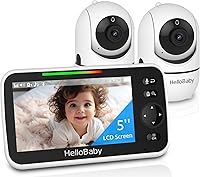
The HelloBaby HB6550 is a video monitor with a 5-inch color display and no WiFi. It pans 355 degrees horizontally and 120 degrees vertically, with 2X zoom and infrared night vision.
It uses 2.4GHz FHSS and digital encryption, with two-way audio, room temperature monitoring and sound level LEDs. The camera needs plug-in power, while the screen has a 30-hour battery average life.
Choose this model if seeing your baby matters more than keeping the monitor audio only. It can also expand to up to 4 cameras, which helps parents watching more than one room.
If you want video but prefer to turn the screen off, read our wifi baby monitor audio only guide. It explains how audio-only saving modes work on video monitors.
VTech Audio Baby Monitor DM111
The VTech DM111 is a simpler audio monitor with an 8-hour rechargeable battery and belt clip. It also uses DECT 6.0, has a 1,000 ft range and a 5-level sound indicator.
You can mute the speaker and still read the LED sound levels. The parent unit can alert you to low battery, out of range or sound above your threshold, and AAA batteries are included as backup.
Choose the DM111 if you want to clip the monitor to your waistband and move through the house, yard or garage. It has no night light and no video, so it is a more basic tool than the DM221.
For a wider VTech comparison, see the best vtech audio baby monitor guide. It places the DM221 and DM111 in the same brand lineup.
Which monitor should you pick?
Pick the DM221 if you want audio monitoring with talk back, vibrating alerts and a night light. It is the best fit here for parents who stay in the home and want clear DECT 6.0 sound.
Pick the HelloBaby HB6550 if you want video without using home WiFi. Its 5-inch screen, pan and tilt camera and night vision add a lot, but it is a video system rather than an audio monitor.
Pick the VTech DM111 if you want a simple, portable audio monitor to carry on your belt. Its 8-hour battery, AAA backup and basic controls suit travel, grandparents and second-room use.
If you need to mount a camera on a wall or shelf, check the best baby monitor wall mount options before you buy. Mounting can help a camera's view, but audio monitors still need safe, out-of-reach placement.
If your home has stairs or two main living areas, compare an audio baby monitor for two rooms. Range figures alone do not prove a monitor will cover every room.
For most parents who asked for a vtech dm221 audio baby monitor review, the DM221 is the right shortlist pick. It keeps the focus on sound and comfort, with a night light that a basic audio monitor does not offer.
Frequently asked questions
Is the VTech DM221 an audio-only monitor?
Yes. The DM221 is an audio monitor that uses DECT 6.0 for sound, talk back and visual sound levels.
It has no camera or screen, so you listen for your baby rather than watch.
If you want video without WiFi, compare the HelloBaby HB6550 in this review.
How far does the VTech DM221 reach?
VTech states up to 1,000 feet of range for the DM221. Real range depends on walls, floors and interference in your home, so test the parent unit in the rooms where you will use it most.
Keep the baby unit at least 3 feet from the parent unit during setup as VTech directs.
Can you talk to your baby through the DM221?
Yes. The parent unit has a built-in intercom for two-way talk back to the baby unit.
You can also use the parent unit to turn the baby unit night light on or off.
That makes it useful for a quick reassuring word without walking back to the nursery.
What power does the DM221 parent unit need?
The parent unit runs on a rechargeable Ni-MH battery or AC power. VTech says to use both battery and AC power at the same time for continuous monitoring, since battery alone runs the parent unit cordlessly for a short time only.
A full battery charge takes 12 hours.