Portable Crib Mattresses: How to Choose the Right Fit
A portable crib mattress is the right choice when its exact length, width and thickness leave no gap around the crib walls: measure the inside of the crib first, pick a firm flat surface made for that size, and follow the crib maker's replacement rules for travel use.
On this page (12 sections)
- How do you measure a portable crib for the right mattress fit?
- Why does a gap around a portable crib mattress matter?
- How is a portable crib mattress different from a mini crib mattress?
- What does the crib maker specify for a travel crib replacement mattress?
- How firm should a portable crib mattress feel for a baby?
- Which support type works best in a portable crib mattress?
- How do you choose a travel crib mattress that is easy to clean?
- What thickness works for a portable crib mattress?
- How do you pack, store and set up a portable crib mattress for travel?
- Which brand sizes should you check if you own a Dream On Me crib?
- When should you choose an organic or specialty portable crib mattress?
- How do you make the final pick for a portable crib mattress?
A portable crib mattress gives your baby a firm, flat sleep surface in a folding travel crib. It only works when it fits that exact crib with no loose space around the edges.
Measure the inside of the frame before you buy. A mattress that is too small can shift.
A mattress that is too large will not sit flat. Both problems make sleep less safe.
How do you measure a portable crib for the right mattress fit?
Measure the inside length, inside width and inside depth of the crib at mattress height. Write down each number in inches and keep it with the crib manual.
Use a tape measure across the longest interior side, then across the shortest interior side. Check both ends because some frames taper or curve near the legs.
Also measure from the mattress support to the top rail to confirm the mattress depth will not push the baby too close to the rail.
What numbers do you need before you shop?
You need length, width, thickness and the crib brand and model. Those five details decide the size.
Brand names alone do not tell you the fit, because two portable cribs from one maker can use different mattresses.
If the crib came with a mattress, keep that mattress as your size guide. If it did not, use the manual size given by the crib maker.
That manual size matters more than a generic shop label such as small, mini or travel.
Our crib mattress comparison guide walks through standard and nonstandard sizes. Read it before you order, because portable frames are rarely standard size.
Rule: buy only after you have matched the crib's inside length and width to the mattress size in inches.
Why does a gap around a portable crib mattress matter?
A gap matters because a baby can roll or shift into it during sleep. Even a small space can trap a face or limb.
A snug fit keeps the mattress from moving when your baby pushes against the side.
Check all four sides after you place the mattress. Look at the corners, where many frames leave more room.
Press the mattress toward each rail and see if any side slides away. If it does, the size is wrong for that crib.
A sheet can hide a gap but it cannot fix one. Sheets add fabric, not support.
They also can bunch if the mattress is too small, which creates another loose fabric risk.
Rule: if you can fit fingers into a gap on any side, choose a different size.
How is a portable crib mattress different from a mini crib mattress?
A portable crib mattress is made for a folding travel frame, while a mini crib mattress is made for a smaller stationary crib. The frames are built in different ways, so the mattress sizes do not match.
Mini cribs often use a category size near 38 by 24 inches. Portable cribs vary by model and can be shorter, narrower or both.
A mini crib mattress may be too thick for a travel frame or too wide for its base.
The reverse is also true. A thin travel mattress may sit too low in a mini crib and leave a high rail gap.
It may also lack the firm support that a stationary crib mattress is built to give.
For a stationary small crib, see which nestig mini crib mattress size fits that model. Do not carry that size over to a travel frame by guess.
Rule: name the crib type first, then shop for the mattress made for that type and model.
What does the crib maker specify for a travel crib replacement mattress?
The crib maker specifies the only safe replacement size for that frame. Follow that size even when another mattress looks close on a shop page.
Check the manual, the frame label and the maker site for the exact replacement part. Some makers sell their own replacement mattress.
Others give dimensions that let you buy from another brand. The manual will tell you which path to use.
If you cannot find the size, contact the maker before you buy. Bring the model number and serial number.
Do not trim a mattress, fold it to fit, or stack two thin mattresses to make up depth.
Our guide to how to choose crib hardware explains why maker parts matter for fit and safety. Frames, supports and mattresses work as a set.
Rule: use the maker specified replacement size, or do not use a replacement mattress in that crib.
How firm should a portable crib mattress feel for a baby?
It should feel firm and flat across the whole surface. Your hand should not sink into a soft pocket in the center.
The edges should not bow or sag when you press them.
Newborns and infants need the firmest side. Some mattresses have an infant side and a toddler side.
Use the infant side first, then flip the mattress only when your child is a toddler and the maker says the second side is for that stage.
A travel mattress that feels thin can still be firm, but thinness is not the same as support. Foam density, coil count and cover tension all affect how it holds shape.
A good test is to press evenly around the surface and look for soft spots.
For support options in general, see how to compare crib mattress support types. That guide explains coils, foam and hybrid builds in plain terms.
Rule: pick firm and flat for infant sleep, and skip any mattress that sags or feels soft in the middle.
Which support type works best in a portable crib mattress?
Coils, foam and hybrids each work in a travel crib when the size and firmness are right. The best type depends on weight, cleaning needs and how long you will use it.
Coils give a firm, springy feel and hold shape over time. They can be heavier to carry and pack.
Foam is lighter and often easier to fold or pack for trips. A hybrid adds coils for support with a foam or fiber layer on top.
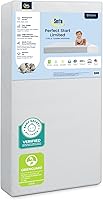
That Sealy design shows what coil support looks like in a full-size mattress. It has an extra-firm infant side and a toddler side.
Its size is a reminder to check dimensions first, because a standard size will not fit most portable frames.
Foam, coils or hybrid for travel use
Foam suits families who pack the crib often, because many foam cores weigh less than coil cores. Coils suit families who want a long use span and do not mind extra weight.
Hybrids can split the difference, but depth and foldability still need a check.
Rule: choose the support type you will carry, clean and store without bending it out of shape.
How do you choose a travel crib mattress that is easy to clean?
Choose a cover you can wipe clean or wash on a regular schedule. Spills, diaper leaks and travel germs are normal, and a cover that is hard to clean will not stay fresh.
A waterproof surface helps block moisture from reaching the core. That matters in a portable crib, where a leak can soak a thin mattress fast.
Check whether the cover zips off, wipes down or needs spot cleaning only.
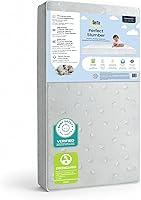
The Graco design shows a washable cover system in a full-size format. For a portable crib, look for the same practical features in the portable size you need.
Wash the cover in cold water on a delicate cycle, with no bleach, and hang it to dry.
A snug sheet helps on any crib mattress, but only when the sheet size matches the mattress. A sheet that is too large can bunch.
A sheet that is too small will pull at the corners and creep up during the night.
Rule: pick a cover and sheet you can clean fully and keep snug, with no loose fabric.
What thickness works for a portable crib mattress?
A portable crib mattress should be thick enough to stay firm and flat, but not so thick that it lifts the baby near the rail. The crib depth decides the safe range.
Measure from the mattress support to the top of the side rail. The top of the mattress must stay well below the rail when it is in place.
A thick mattress in a shallow travel frame can reduce that safe distance.
Thin mattresses need extra care. They can fold or kink if you store them rolled for a long time.
They also show every bump on the support frame. Check the surface after you set the crib up, and fix any uneven spot before use.
Many portable cribs have a fabric base rather than slats. That base can flex under a heavy mattress.
Keep the total weight within the maker limit for the frame.
Rule: let the rail depth set the maximum thickness, and never stack mattresses to reach it.
How do you pack, store and set up a portable crib mattress for travel?
Pack the mattress flat or in the fold the maker allows. Do not force a foam core into a tight roll for weeks, because that can leave a crease that changes how it feels.
When you arrive, set the crib up on a level floor. Lock each leg or joint and check the base before you add the mattress.
Place the mattress in the crib, press it to each side and confirm that no gap remains.
Let a compressed foam mattress expand fully before first use. The Graco foam model above says to allow up to 48 hours for full expansion after unboxing.
That wait applies to foam mattresses that ship compressed, so plan ahead rather than using it right away.
If the mattress smells strong when you open it, air it out in a safe, ventilated space and follow the maker care steps. Do not place it in the crib until it is flat, clean and fully expanded.
For a smaller stationary option, our best extra firm mini crib mattress guide lists firm picks by exact size. Use it only when your crib is a mini crib, not a travel frame.
Rule: set the crib up first, lock it, then add a fully expanded mattress and check the fit on all four sides.
Which brand sizes should you check if you own a Dream On Me crib?
Check the exact Dream On Me model before you order any mattress. The brand makes full-size, mini and portable frames, and each one uses a different size.
A dream on me bassinet mattress fits a bassinet, not a portable crib. A mini crib mattress fits a mini crib, not a travel frame.
Even two Dream On Me models with similar names can need different lengths.
Start with the model number on the frame or manual. Then match that number to the replacement size given by Dream On Me.
If the maker sells a replacement mattress for that model, that is the safest match.
If you own a Dream On Me mini crib, our best dream on me mini crib mattress guide helps you compare sizes for that frame. Keep it separate from travel crib shopping.
Rule: match the model number first, and never assume one Dream On Me size fits another model.
When should you choose an organic or specialty portable crib mattress?
Choose an organic or specialty cover when the size fits and the care steps suit your routine. Organic fabric on the sheet does not change the mattress size or firmness.
Our best organic mini crib mattress guide covers organic options for mini cribs. For portable cribs, check whether the maker offers an organic cover in the exact portable size.
Do not buy a mini size and hope it fits a travel frame.
Some buyers want a cover screened for chemicals, a waterproof layer or a washable outer layer. Those goals are fair, but they come after fit and firmness.
A certified cover on the wrong size is still the wrong mattress.
If your crib is exactly 38 by 24 inches, our best mini crib mattress 38x24 guide covers that stationary size. That size is common for mini cribs and uncommon for portable frames, so confirm your crib type before you use it.
Rule: add specialty features only after the size, firmness and maker rules already pass.
How do you make the final pick for a portable crib mattress?
The right portable crib mattress is the one that fits your crib with no gaps, feels firm and flat, and follows the maker size rule. Start with the crib model, then measure, then compare firmness and cleaning.
Write your crib's inside length and width on paper. Cross out any mattress that does not match those numbers.
That one step removes most wrong picks. Then check depth against the rail, weight against the frame limit and cover care against your travel routine.
Coils, foam and hybrids can all work when the size is right. Washable covers and waterproof layers help with daily use.
Organic sheets help with comfort, but they do not fix a size mismatch.
Rule: measure first, match the maker size, and pick firm and flat for infant sleep.
Frequently asked questions
What size is a portable crib mattress?
A portable crib mattress size depends on the crib model, not a single standard. Measure the inside length, width and depth of the crib, then choose a mattress that fits snugly with no gap where a baby could get stuck.
Always follow the crib maker's specified replacement size.
Can I use a standard crib mattress in a portable crib?
No. A standard crib mattress is about 52 by 28 inches and will not fit most portable cribs.
It can be too large, too thick or too soft for the frame.
Use only a mattress made for that portable crib model.
What is the difference between a mini crib mattress and a portable crib mattress?
Mini crib mattresses are made for smaller stationary cribs, often about 38 by 24 inches. Portable crib mattresses are made for folding travel frames, which vary more by brand.
The crib model decides which size you need.
How firm should a travel crib mattress be?
It should be firm and flat, with no sag in the middle. A firm infant side and a slightly softer toddler side can work when the maker gives two stages.
If it feels soft, thin or uneven, do not use it for sleep.