Can You Use a Crib Mattress Wedge or Riser?
Don't use a crib mattress wedge or riser for routine sleep. A baby's sleep surface should stay firm, flat, level, and tightly fitted inside the crib.
On this page (7 sections)
- Why is a crib mattress wedge unsafe?
- Can a crib mattress riser help with reflux?
- What should a safe crib mattress setup look like?
- Which crib mattresses fit a flat sleep setup?
- How do mattress height settings differ from a riser?
- Can you use other crib mattress accessories?
- What should you do if the mattress does not fit flat?
Don't use a crib mattress wedge or riser for routine sleep. An added incline can let a baby slide, create gaps, or place the body in an unsafe position.
This matters for every nap and for every night, not only for the first few weeks at home.
A baby cannot always correct the position once the body has shifted on a tilted surface.
The safer setup is a firm, flat, level crib mattress with a fitted sheet and no extra sleep accessories.
That plain setup gives a newborn steady support and gives parents one less thing to adjust during the night.
A wedge and a riser are not the same item, but both can change the mattress angle.
A wedge sits under part of the mattress, while a riser lifts one end or raises the mattress platform.
Both approaches move the surface away from the flat position the crib was designed to provide.
The tilt may look small, yet it can still change how a small body rests and moves.
Adding material under the mattress can also affect fit, so the mattress may no longer sit evenly on its support.
That shift can leave a gap at one side or make the surface feel uneven under a sheet.
Neither belongs under a baby's crib mattress unless a qualified clinician and the crib manufacturer give specific, compatible instructions.
A general hope that an incline will help is not the same as specific, compatible guidance for a given baby and crib.
When in doubt, keep the mattress level and ask the baby's clinician about any feeding or breathing concern.
Parents can then focus on fit, firmness, and a clear sleep space, which are the parts of the setup they can control at home.
Why is a crib mattress wedge unsafe?
A crib mattress wedge can make the sleep surface uneven or change how a baby rests on it. Babies may slide downward, turn into a position they cannot correct, or encounter a gap between the mattress and crib frame.
The problem is not only the angle. Adding material under the mattress can also affect the fit, the way the mattress rests on its support, and the height of the mattress relative to the crib rails.
The American Academy of Pediatrics recommends placing babies on their backs on a firm, flat sleep surface. The AAP safe sleep recommendations explain why inclined sleep products and extra bedding should not replace a clear, level crib.
Can a crib mattress riser help with reflux?
A crib mattress riser is not a routine treatment for reflux or congestion. Raising one side of the crib can increase sliding and does not make an unsafe sleep position safe.
It is understandable to look for anything that might make a baby more settled after feeding.
Families often hope that raising the head end will reduce spit-up or help noisy breathing settle.
A riser does not turn an inclined sleep surface into a safe one, even when the tilt seems gentle.
The body can still move toward the lower end, which changes the position for the head, neck, and torso.
That movement can also pull the mattress out of its intended fit or leave space beside it.
For this reason, a riser should not be used as a routine answer for reflux or congestion.
If your baby has frequent spit-up, noisy breathing, poor feeding, or ongoing sleep trouble, speak with a pediatrician.
Those signs deserve direct clinical advice, especially when they happen often or affect feeding and growth.
Don't use an inclined mattress, pillow, rolled towel, or improvised support while waiting for advice.
Keep the crib flat and clear in the meantime, with only a fitted sheet on the mattress.
Watching how your baby feeds, breathes, and grows gives the clinician useful details to consider.
Bring notes about timing, amount of spit-up, and any change in sleep or feeding patterns.
That discussion can lead to a plan that fits your baby, rather than a change to the mattress angle.
For general mattress fit and safety checks, use this guide to crib mattress safety. It covers the details that matter more than adding an incline, including firmness, fit, and a properly sized sheet.
Check firmness by pressing the surface and confirming it stays firm without a deep dip.
Check fit by looking for gaps at the sides, ends, and corners after the sheet is in place.
Check the sheet by confirming it stays snug and does not loosen during normal care.
Those checks take only a few minutes and can be repeated after moving the crib or changing its height.
A flat, well fitted mattress remains the right foundation while you seek guidance for reflux or congestion.
What should a safe crib mattress setup look like?
A safe setup has one firm, level mattress and one fitted sheet. The mattress should fit the crib without visible gaps, and the sheet should stay tightly secured at the corners.
Check the mattress after moving the crib, changing the height setting, or replacing the sheet. Press around the edges and corners to make sure the mattress has not shifted or lifted.
A crib mattress comparison guide can help you compare size, thickness, firmness, cover material, and cleaning features without treating an incline as a benefit.
Can a firm mattress replace a crib mattress wedge?
A firm crib mattress is the correct foundation, but firmness does not make a wedge safe. Choose a mattress made for the crib and keep it level rather than trying to increase support with an accessory.
For newborn-focused choices, see best crib mattresses for newborns. If you are comparing foam and fiber constructions, How to Compare Crib Mattress Support Types explains what those materials mean in daily use.
Which crib mattresses fit a flat sleep setup?
These mattresses are useful examples because each is designed as a crib or crib-and-toddler mattress. They do not require a wedge or riser, and each should be used according to its stated size, fit, and care instructions.
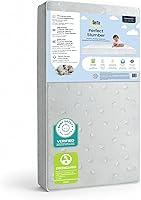
The Delta Children Serta Perfect Slumber Dual Sided Crib has a firm fiber core, a waterproof vinyl cover on both sides, square corners, and a size of 52 in L x 27.5 in W x 5 in thick. Its dual-sided design supports flipping the mattress when a child moves to a toddler bed.
Its fiber core is made from sustainably sourced material described as upcycled plastic bottles. Delta Children also identifies it as GREENGUARD Gold certified, JPMA certified, made in the USA, and covered by a 7-year warranty.
Allow 24 to 72 hours for the mattress to regain its full shape after compression.
The Graco Premium Foam Baby Crib & Toddler measures 52 in L x 27.6 in W x 4.5 in thick and has a firm high-density polyurethane foam core. Its waterproof sleep surface has a removable polyester cover that can be machine washed cold on a delicate cycle, without bleach, then hung to dry.
Graco describes the cover as OEKO-TEX STANDARD 100 certified and the mattress as GREENGUARD Gold certified, UL Formaldehyde Free Validated, CertiPUR-US certified, and Baby Safety Alliance Verified. It ships compressed, so unbox it at room temperature and allow up to 48 hours for full expansion.
The Dourxi Crib Mattress, Dual Sided Comfort Gel Memory Foam Toddler Mattress measures 52 in L x 27.5 in W x 6 in thick. It has a firmer infant side, a slightly softer toddler side, a gel-infused memory foam layer, an open-cell memory foam layer, and a high-density support core.
Dourxi describes the cover as removable and washable, and the foam as CertiPUR-US certified and free of phthalates, lead, and mercury. The mattress is compressed for transport and should expand for at least 72 hours at room temperature before use.
How do mattress height settings differ from a riser?
A crib's built-in mattress height setting is part of the crib's design, while an added riser is an external change. Use only the positions and hardware approved for that crib model.
A higher approved setting can make it easier to reach a young baby. As the baby grows and begins to sit or stand, the mattress usually needs to move lower according to the crib instructions.
Read How Many Mattress Height Settings Does a Crib Need? before changing a crib platform. Never place books, blocks, wood pieces, folded blankets, or other objects under the mattress support.
Can you use other crib mattress accessories?
Avoid accessories that change the mattress angle or add soft material to the sleep surface. That includes wedges, risers, toppers, pillows, positioners, and rolled towels.
A vibrating mattress is a separate question from an inclined mattress. Read vibrating crib mattress if you are considering movement or vibration, and follow the product and crib instructions closely.
For a basic choice, compare best firm baby crib mattress and focus on a firm feel, correct dimensions, a tight fit, and a flat installation. A fitted sheet is the only routine bedding item needed.
If you use a portable crib, do not assume a standard full-size crib sheet will fit. Check best portable crib size sheets for the importance of matching the sheet to the exact sleep surface.
What should you do if the mattress does not fit flat?
Stop using the setup until the mattress sits flat and fits tightly. Remove any wedge or riser, check that the support platform is assembled correctly, and compare the mattress dimensions with the crib instructions.
Don't force a mattress into place or fill a gap with padding. A mattress that bows, rocks, leaves a visible space, or catches on the frame needs a careful fit check before a baby sleeps in the crib.
The decision rule is simple: choose a crib mattress made for the crib, install it on the approved support at the correct height, and keep the surface flat and clear. Pick a firm mattress with the right dimensions, not a crib mattress wedge or riser.
Frequently asked questions
Can you use a wedge under a crib mattress?
No. A wedge under a crib mattress can create an incline or gap, so don't use one for routine infant sleep.
Keep the mattress flat, firm, and level in the crib, with only a fitted sheet designed for that mattress.
Ask a pediatrician about medical concerns instead of adding an accessory.
Can a crib mattress riser help with reflux?
A crib mattress riser isn't a safe routine solution for reflux. Raising one end can let a baby slide or place the body in an unsafe position.
Discuss persistent feeding or sleep concerns with your baby's clinician, and follow current safe-sleep guidance for every nap and night.
How firm should a crib mattress be?
A crib mattress should be firm enough that it doesn't form a deep indentation under a baby's weight. It should fit the crib tightly, stay flat, and have a fitted sheet with no loose bedding, pillows, toppers, or positioners.
What can you put on a crib mattress?
Use a fitted crib sheet made for the mattress and nothing else for routine sleep. Don't add wedges, risers, toppers, pillows, blankets, toys, or sleep positioners.
Check the mattress fit and sheet fit after every change.